
The short version
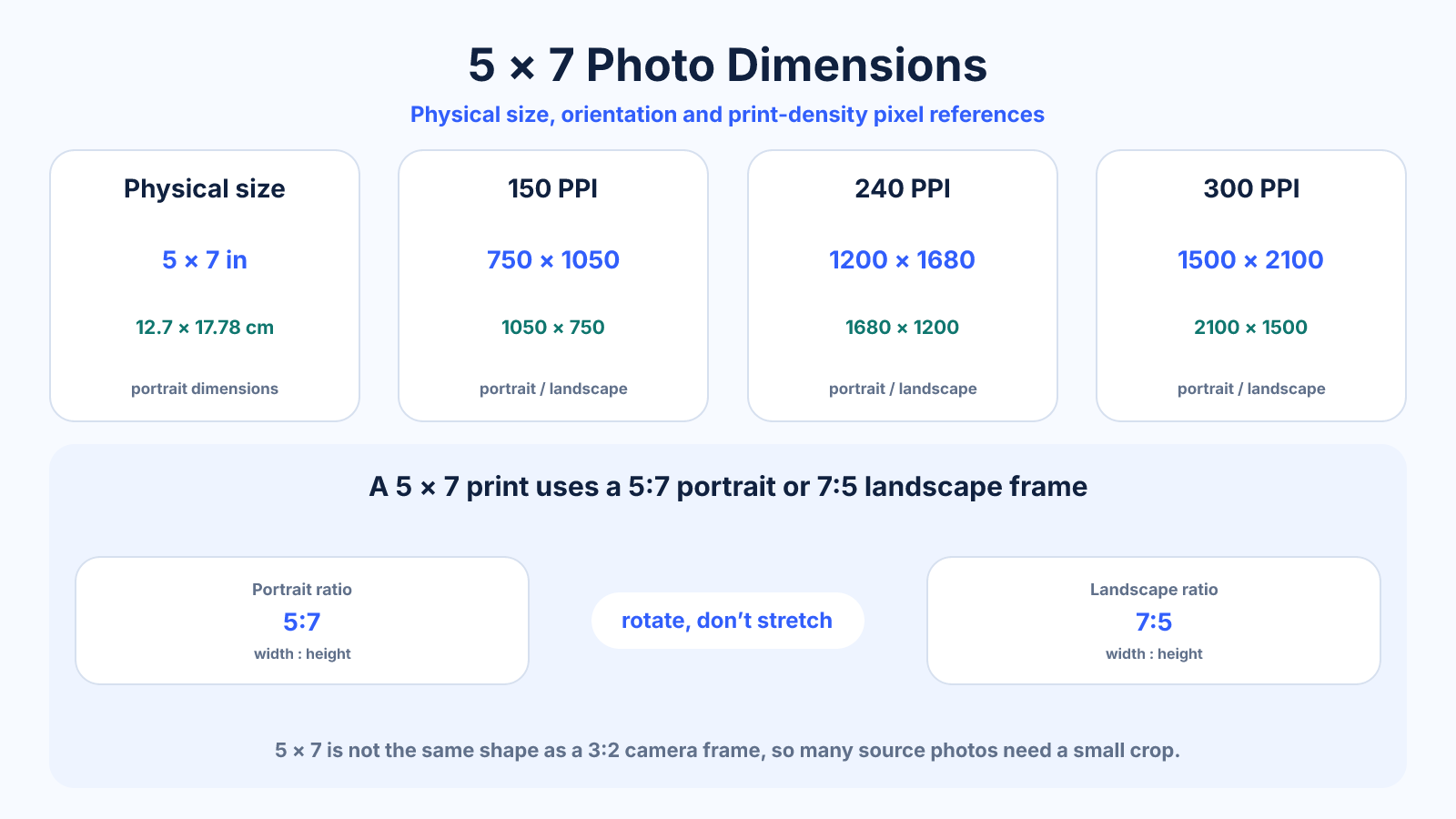
A 5 × 7 photo measures 5 by 7 inches, or 12.7 by 17.78 centimeters. Its portrait ratio is 5:7, and a 300 PPI print requires 1500 × 2100 pixels.
What matters most
- 5:7 is slightly squarer than a 3:2 camera frame.
- A small source crop is normally needed.
- At 240 PPI the target is 1200 × 1680 pixels.
How to apply it
- Select a 5:7 crop preset.
- Move the crop to protect faces and edge details.
- Calculate required pixels from the chosen density.
- Check the print provider's bleed and file requirements.
Reference table
| Density | Portrait pixels | Landscape pixels |
|---|---|---|
| 150 PPI | 750 × 1050 | 1050 × 750 |
| 240 PPI | 1200 × 1680 | 1680 × 1200 |
| 300 PPI | 1500 × 2100 | 2100 × 1500 |
Use exact dimensions and units in production notes; familiar labels can describe more than one standard.
How big is a 5 x 7 photo?
A nominal 5 x 7 print measures 5 inches by 7 inches, equal to 12.7 x 17.78 centimeters or 127 x 177.8 millimeters. Rotate it to 7 x 5 for landscape. The portrait ratio is 5:7 and the landscape ratio is 7:5.
This format is larger than 4 x 6 but smaller than 8 x 10, making it common for desk frames, albums and small portraits. Actual borderless output may be enlarged and trimmed slightly, so a lab's crop preview and finished-size tolerance take priority.
5 x 7 dimensions in pixels
Multiply inches by the target pixels per inch. At 300 PPI, a portrait 5 x 7 requires 1500 x 2100 pixels. At 240 PPI it requires 1200 x 1680, and at 150 PPI it requires 750 x 1050. Reverse width and height for landscape.
These values are preparation targets, not guarantees of sharpness. A correctly sized but blurred or heavily compressed file can still print poorly. Conversely, a clean file somewhat below 300 PPI may work well at this size depending on the print process and viewing distance.
Why 5 x 7 crops a 3:2 or 4:3 photo
A 5:7 portrait has a decimal width-to-height ratio of about 0.714. A 2:3 camera portrait is about 0.667, while 3:4 is 0.75. Because neither matches exactly, filling the paper removes a small amount from one pair of edges.
Preview and reposition the crop before ordering. Protect heads, hands, captions and signatures, and leave extra margin around frame edges. If every source pixel matters, fit the image inside the 5 x 7 canvas and accept a border rather than stretching the subject.
Compared with 4 x 6, a 5 x 7 print is physically larger and slightly squarer. Do not enlarge a finished 4 x 6 crop and assume it will fit: return to the uncropped original, choose the 5:7 frame and make a fresh composition.
Prepare a 5 x 7 file and frame
A frame labeled 5 x 7 normally accepts that print size, but its lip or mat opening may hide part of the edge. Keep essential details inside a conservative safe area. Check whether the frame expects a mat and whether its opening is centered.
Export once from the original at the print provider's requested file format and color profile. High-quality JPEG and sRGB are common consumer-lab choices, but not universal. Avoid repeatedly opening and saving JPEG files because each lossy save can reduce quality.
Common mistakes to avoid
- Treating 5×7 as interchangeable with 4×6.
- Upscaling a small messaging-app image without checking detail.
- Ignoring lab trim tolerance.
Continue with the right tool
Use a calculator to check the numbers against your own source and destination instead of relying on a generic preset.
Related guides
Standard Photo Sizes: Print Dimensions, Ratios and Pixels
Compare common photo print sizes, their aspect ratios and pixel dimensions at 300 PPI before cropping or ordering prints.
Images and photosWhat Is Image Resolution? Pixels, Dimensions and Detail Explained
Understand image resolution, pixel dimensions, megapixels and print density without confusing them with aspect ratio or file size.
Images and photos4×6 Photo Dimensions: Inches, Centimeters, Ratio and Pixels
Find the exact dimensions and 3:2 aspect ratio of a 4×6 photo, including pixels for 150, 240 and 300 PPI printing.
Frequently asked questions
What aspect ratio is a 5×7 photo?
Exactly 5:7 in portrait or 7:5 in landscape.
How many megapixels is 1500 × 2100?
It contains 3.15 million pixels, or 3.15 MP.
Does a 4×6 image fit 5×7?
Not exactly. A 3:2 source needs a modest crop to become 7:5.